
So I made one of these little guys on a whim in February or March of 2024, and haven’t really stopped thinking about him since then:
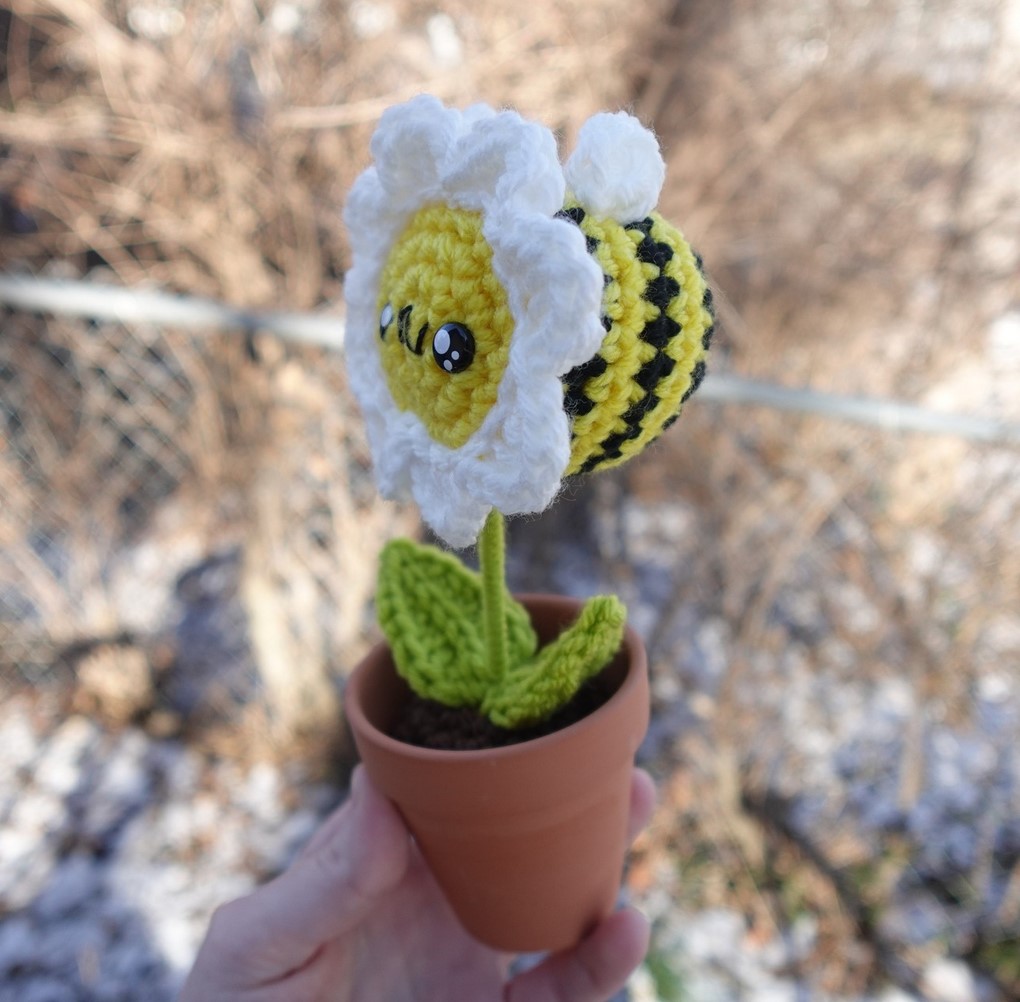
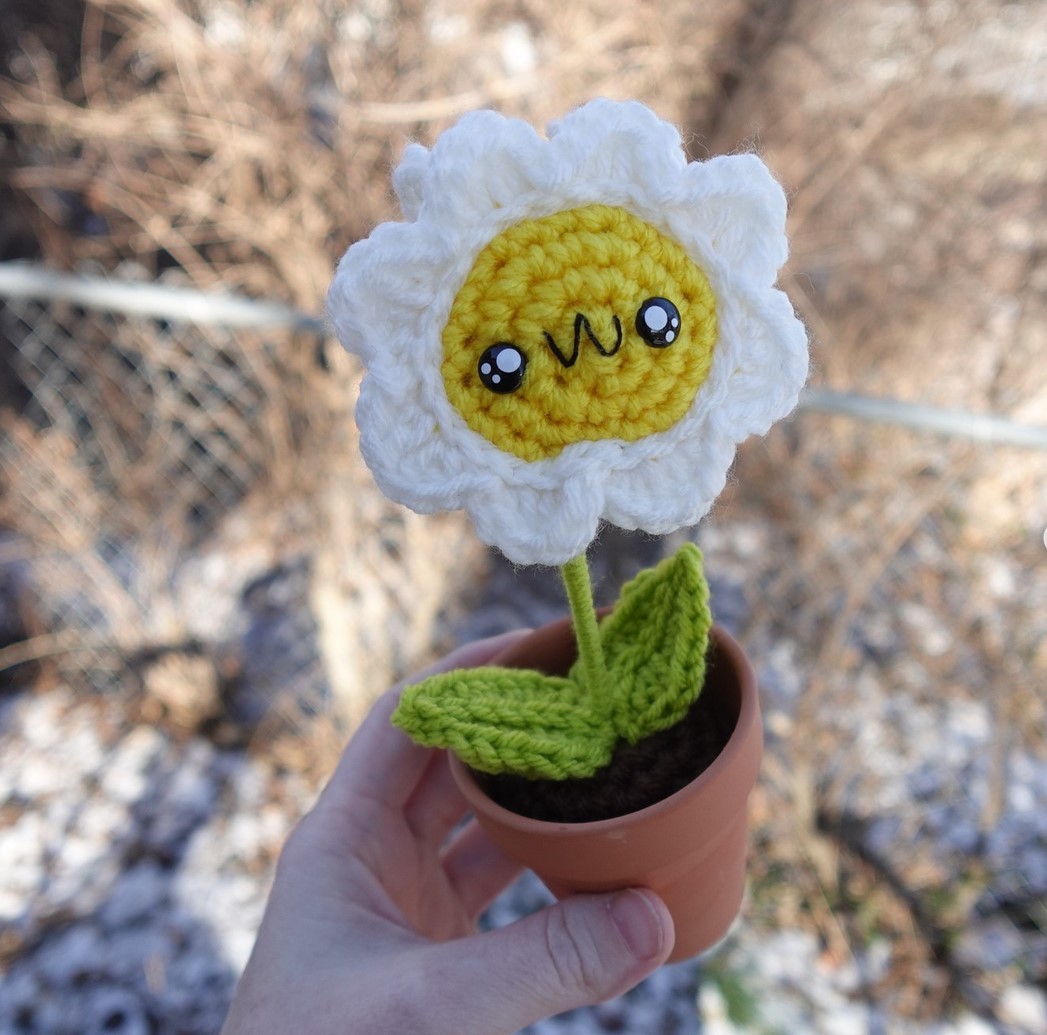
The idea is like his face is a little flower, and then BAM, when you turn him around, and he’s a bee! I made a few modifications to him, though – since I know not everyone has access to the same size terracotta pots I like to use, I decided to whip up a cute crochet flower pot for him, complete with sweet little bow.
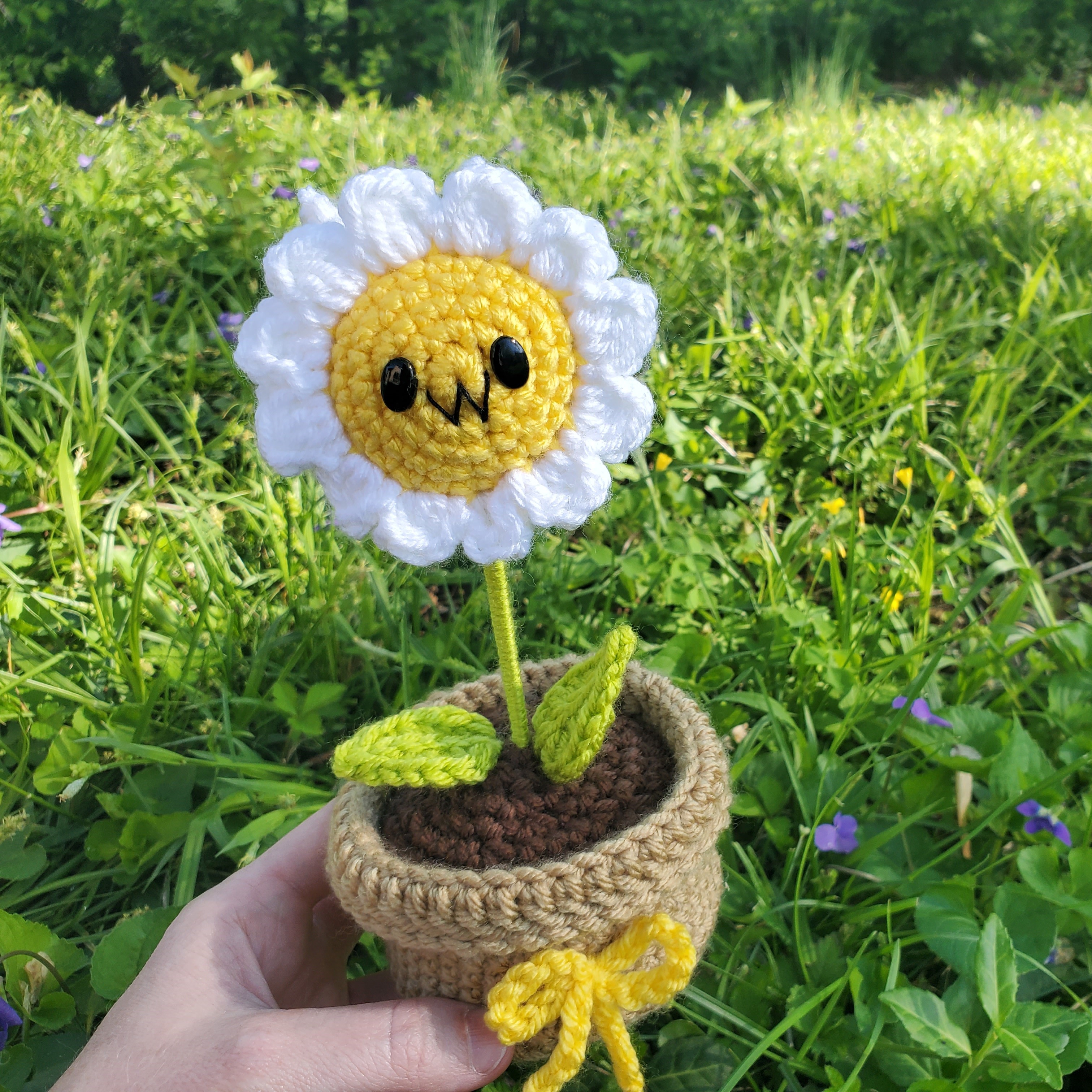


I absolutely love the finished result, especially the cute crocheted bow that uses the same bow as from my Bow Garland pattern! He looked darling out in my backyard for his photoshoot – but I really need to mow the lawn 😅
YouTube Pattern Video
Below you’ll find the pattern video. I use YouTube’s “Chapters” feature to sort each individual instruction (rounds, sewing, sections, etc.) into a time stamped section. You should be able to see the chapters in the timeline/seek bar of the video below, but if you click over to YouTube, you’ll be able to pull the chapters up and move more easily between them.
As always, with the pattern write-up here on my blog, the written instructions are “bare bones” – they’re designed to work hand-in-hand with the video tutorial, so there aren’t a lot of images or descriptive language. If you’re having any issues, please refer to the video! I work hard to make them as clear as possible.
If the video still doesn’t answer your questions, drop me a comment here on the blog or over on the video on YouTube, and I’ll see if I can help you out. ❤
Concepts
I would grade this pattern as an intermediate pattern, because it:
- Has some construction elements, like using floral wire and cardboard
- Uses a bit more sewing than my normal patterns might
- Employs some simple color changing and embroidery
- Has one section where you’ll need to “turn” your work
- Has two separate places where fastening on is required
- Requires working down both sides of a chain
- Uses a 3 dc bobble st
- Requires familiarity with working sc sts, increases and decreases
- Also uses hdc, dc, slp sts, and chs frequently
However, as with all of my tutorials, I’ll guide you through each step to the best of my ability! Don’t be afraid to give it a try, as I do a pretty good job going slow and helping you to master new concepts. We’ll work together so you can make this project and grow your skills as a crocheter!😍
Materials
- Worsted weight yarn in yellow, black, white, light brown, dark brown, and green, or your choice of weight and color – just remember to size hooks and accessories accordingly.
- 4 mm crochet hook (or whatever size you need, based on the weight of yarn you choose)
- 1 pair of 8mm oval safety eyes, or any safety eye of your choice! I get mine from Glass Eyes Online.
- Black embroidery floss/black yarn for mouth
- Your standard amigurumi items: tapestry/yarn needle(s), stitch marker, scissors, stuffing
- Floral wire, or craft wire – I used floral wire, approximately 18 inches long, folded in half on itself for extra support.
- Optional: A scrap piece of cardboard, cut to size, to keep the bottom of the flower pot flat
Pattern Notes
All of my patterns are written with US terminology.
As with most amigurumi projects, your work will be formed by crocheting in a continuous spiral, with a stitch marker marking the beginning of each round. Any other construction style will be indicated in the pattern!
Abbreviations
These are my most commonly used abbreviations. Any special stitches or exceptions will be denoted in the pattern as they appear!
| rnd(s) | round(s) |
| sc | single crochet |
| MR | magic ring |
| ( ) | number of stitches at the end of each round |
| * * | repeat instructions, in the order they appear, the indicated amount of times |
| inc | increase (typically single crochet – otherwise denoted) |
| BLO | work in the back loop only |
| FLO | work in the front loop only |
| slp st | slip stitch |
| dc | double crochet |
| hdc | half double crochet |
| ch | chain |
| st(s) | stitch(es) |
| YO | yarn over |
Pattern
Bee Body
Begin with yellow yarn and by forming a MR.
Rnd 1: 6 sc in MR (6)
Rnd 2: *inc* x 6 (12)
Rnd 3: *1 sc, 1 inc* x 6 (18)
Rnd 4: *2 sc, 1 inc* x 6 (24)
Rnd 5: 1 sc in each st around
Rnd 6: in BLO, 1 sc in each st around
Switch to black yarn here, leaving yellow attached.
Rnd 7: in black and no longer working in BLO, 1 sc in each st around
Switch back to yellow yarn, leaving black attached.
Rnd 8-9: in yellow, 1 sc in each st around [2 rnds sc total]
Switch back to black yarn, leaving yellow attached.
Rnd 10: in black, 1 sc in each st around
Switch back to yellow yarn, leaving black attached.
Rnds 11-12: in yellow, 1 sc in each st around [2 rnds sc total]
Switch back to black yarn, leaving yellow attached.
Rnd 13: in black yarn, *2 sc, 1 dec* x 6 (18)
Fasten off black yarn here and weave in tail. Continue working in yellow.
Rnd 14: in yellow, *1 sc, 1 dec* x 6 (12)
Add safety eyes here, to the front of the bee (where the MR round is!) – eyes go between Rnds 2 & 3, with the MR opening centered between them. Be really careful to place the eyes so they aren’t skewed. I always have difficulties getting it just right over the top of my work, and will fiddle with the eyes until they’re JUST right.
Insert doubled over floral wire here by poking up through the center bottom of the bee – I poke the doubled over section (the “U” shape, not the two ends) up through the fabric of the second black stripe. Then, form a spiral with the floral wire inside of the bee’s body to keep it secured. I wrap the wire around my fingers a few times to loop it, then fold it so that spiral shape sits flat against the bottom of the bee’s body on the inside.
Next, stuff the bee’s body. We’ll add a bit more after our next round too.
Rnd 15: *dec* x 6 (6) – note, I like to work this round with FLO decreases, as it helps hide the stuffing better.
Speaking of stuffing, add just a pinch here!
Last, before we close this bee up, take a long length of the green yarn, and thread your tapestry needle with it. Tie a knot at the end of this length of yarn, then send the yarn into the bee’s body and out through as close as you can get to the floral wire stem. We’ll be winding this around the wire, covering the wire to make it more like a stem! Just leave as is for now.
Fasten off by slp st to next st, then cut a long tail to sew with. Use this tail to sew through each FLO of the remaining sts, pulling tightly to cinch the round closed. Tie a knot to secure, then weave this tail in.
Using black embroidery floss or black yarn, embroider on the bee’s smile. I make mine have a little “W” shape, with the center of the “W” coming out of the MR opening. Once sewn, secure with a knot and weave in any remaining tail.
Bee Flower
With white yarn, fasten on to any loop on the bee’s face from Rnd 6. Then, *ch 2, in next st place 3 dc bobble, ch 3, slp st in next st* repeat all the way around, forming 12 petals total. On the last petal, you’ll slp st to the first st you fastened on to.
3 dc bobble: *YO, insert into next st, YO, draw through 1 loop on hook, YO, draw through 2 loops on hook* repeat 3 times total. To close, YO and pull through all remaining loops on hook.
Cut a short tail, and weave in both fasten on tail and fasten off tail.
Bee Wings, make 2!
With white yarn, form a MR.
Rnd 1: 8 sc in MR (8)
Cut a long tail to sew with, then slp st to the 1st sc you made, pulling through the slp st with both the tail you cut and the MR tail together. Pull both tightly, one at a time.
Once both wings are crocheted, thread your tapestry needle with the MR tail (the shorter of the two!). Send this tail into the body where you’d like to place either wing – I sew mine on the top of the bee, in line with either eye, and into the 2nd black stripe. Weave these two tails in first, then come back around and sew the wings on using the longer of the two tails, whip stitching through the bottom of the wings right where they meet the body.
Tie a knot with each of these tails and weave them in, too.
Pot
With light brown yarn, form MR.
Rnd 1: 6 sc in MR (6)
Rnd 2: *inc* x 6 (12)
Rnd 3: *1 sc, 1 inc* x 6 (18)
Rnd 4: *2 sc, 1 inc* x 6 (24)
Rnd 5: *3 sc, 1 inc* x 6 (30)
Rnd 6: *4 sc, 1 inc* x 6 (36)
Rnd 7: *5 sc, 1 inc* x 6 (42)
If adding the cardboard to your pot, now’s a good time to measure it out. Place your crocheted circle on a scrap of cardboard, then use a pencil to go around the outside, drawing the right size circle on the cardboard scrap. Cut this circle out, and set aside for now – we’ll place it in closer to the end of the pot.
Rnd 8: in BLO, 1 sc around
Rnds 9-14: no longer in BLO, 1 sc in each st around [6 rnds sc total]
Rnd 15: in FLO, 1 sc around
Rnds 16-17: no longer in FLO, 1 sc in each st around [2 rnds sc total]
Rnd 18: Slp st to next st, then ch 3. Turn work, so the open end of the pot is facing down – now, working in the FLO of the last rnd, place 1 dc in each FLO around to form the lip of the pot.
Rnd 19: slp st in each st around.
Fasten off, leaving a long tail for sewing. Use this tail to tack down a few stitches of the brim here, then tie a knot and weave any extra tail in.
If using the cardboard circle, slot it into the bottom of the pot here.
Soil
With dark brown yarn, fasten on to the BLO left behind on the inside of the pot. I like to roll the top of the pot down to make these stitches easier to get at.
Rnd 1: *5 sc, 1 dec* x 6 (36)
Rnd 2: *4 sc, 1 dec* x 6 (30)
Rnd 3: *3 sc, 1 dec* x 6 (24)
Rnd 4: *2 sc, 1 dec* x 6 (18)
Rnd 5: *1 sc, 1 dec* x 6 (12)
Add some stuffing here, sending plenty to the outsides and to the bottom of the pot.
Rnd 6: *dec* x 6 (6)
Slp st to next st, and then cut a long tail to sew with.
Next, we’ll add the bee’s wire – first, we need to wrap the wire with the green string. Twist it around and around the wire (I usually hold the string and spin the wire with my fingers to wrap it). Once you’ve gotten about 3/4th of the way down the wire, sandwich the yarn between the two strands, then tie a knot around one of the strands to keep the wraps secured.
Now we’ll take the wire and add another bend/spiral shape to it, to keep it locked into the soil, just like we did with the bee at the top. Place inside the opening of the soil, and add a little more stuffing on top.
Last, take the tail from the soil and use it to sew through each FLO from the last round. Pull tight to close the soil off, then sew a few stitches under the wire inside to help secure it. Once sewn closed, tie a knot and weave in any remaining tail.
Leaves, make 2!
With green yarn, ch 6 sts. Working in the 2nd ch from your hook, place 1 slp st, 1 sc, 1 hdc, 1 hdc + 1 dc down the chain. In the last st, place 3 dc sts – now working up the other side of the chain, place 1 dc + 1 hdc, 1 hdc, 1 sc, 1 slp st.
To close off the top of the leaf, place 1 sc in the slp st on the other side of the leaf – then, working through the centers of the chain, slp st down the center, adding the “vein” of the leaf.
Fasten off, leaving a long tail to sew with.
Attach leaves to either side of the stem, using the tails from fasten off to sew them to the soil at the very base of the stem. Tie a knot to secure and weave in any remaining tails.
Bow
With yellow yarn, ch 45 sts. Then, cut yarn, and pull either end very tightly to secure.
Next, we’ll form the bow – I used the exact same bow technique from one of my previous post’s where we’ll take a little scrap of the same color of yarn as the bow, then cross it over on itself and tie it closed. Give the above link a click for better step by step pictures, or tune into the video tutorial for this part!
Using the remainder of the tail from forming the bow, sew the bow to the front of the pot.
Complete!

As always, thanks for tuning in. If you haven’t already checked out my YouTube page, I’d be forever grateful if you’d consider subscribing or watching my other tutorial videos. I try to post twice a month with a new tutorial!
Normal, obligatory legal banter:
Please, if you’d like to share this pattern, link folks directly to this blog page, or to the video on YouTube. I work really hard on my patterns and post them for free – please don’t copy my stuff and sell it as your own pattern! You can make and sell items made from this pattern – and while I would love a mention on the listing or a link back to my blog, it’s not a requirement.
Have an Instagram and want to post your new make? Tag me (@pixeledpeach) so I can see and promote your page!


 Pixeled Peach
One thought on “Bee Balm – Potted Flower Bee Amigurumi Pattern + Video Tutorial”